

Good Weil it lasts – US Big Law Elite
Download the PDF of this article here >>
3 November 2026
By Scott Gibson and Sloane Poulton, Directors at Edwards Gibson

The extraordinary proposed wind-down of Weil dominated our 95th (September – October) edition of Law Firm Partner Moves in London, accounting for 20 London moves (19 laterals) with doubtless more to come in our future editions as the remaining Weil émigrés resurface at new homes. Weil’s implosion is all the more remarkable because this was not an intrinsically broken or unprofitable business: it generated approximately $2.1bn in revenue last year, with profits per equity partner reportedly exceeding $5m, and there was no obvious debt crisis, catastrophic client loss or external shock which should have killed it. Yet, following an accelerating run of partner departures, failed merger discussions and incoming executive partner Ramona Nee’s decision not to take up the top job, on 28 October the firm’s management committee recommended that the partnership be dissolved.
We examine the causes and wider implications in considerably more detail in our recent Global Legal Post article, Live by the lateral, die by the lateral: How Weil was pulled apart by Big Law’s star culture.
For regular Edwards Gibson readers, the underlying mechanism should be familiar. In April 2025, Big Law Jenga: How Private Capital Stars Are Making Elite Firms Unstable warned that the rise of highly paid private-capital rainmakers with exceptionally valuable and portable client relationships, alongside an influx of lateral hires, changes to traditional partnership structures and widening compensation differentials, was weakening the institutional DNA and cohesion of elite partnerships and increasing the risk of a self-fulfilling “run on the partnership”, under which even a strong and profitable elite firm could rapidly collapse.
The danger is particularly acute for elite US firms heavily dependent on a concentrated and predominantly private-capital client base. Combine that concentration risk and increasingly portable rainmaker relationships with US partnership structures which, unlike their UK cousins, offer relatively little friction when partners leave, and apparently formidable firms can become surprisingly vulnerable when confidence starts to fracture.
We sounded a similar warning in a Bloomberg article in August 2025, arguing that external hiring and widening pay disparities risked eroding the collaboration and shared purpose that traditionally bind law firm partnerships, creating a more mercenary and potentially unstable environment. As we put it at the time: “Too many lateral hires can breed resentment. Super elite firms are probably more vulnerable structurally than any time in their history.” We argued the particular danger was that, if profits were suddenly to fall, highly paid partners with increasingly portable practices could quickly leave for better opportunities elsewhere, potentially destabilising the firm.
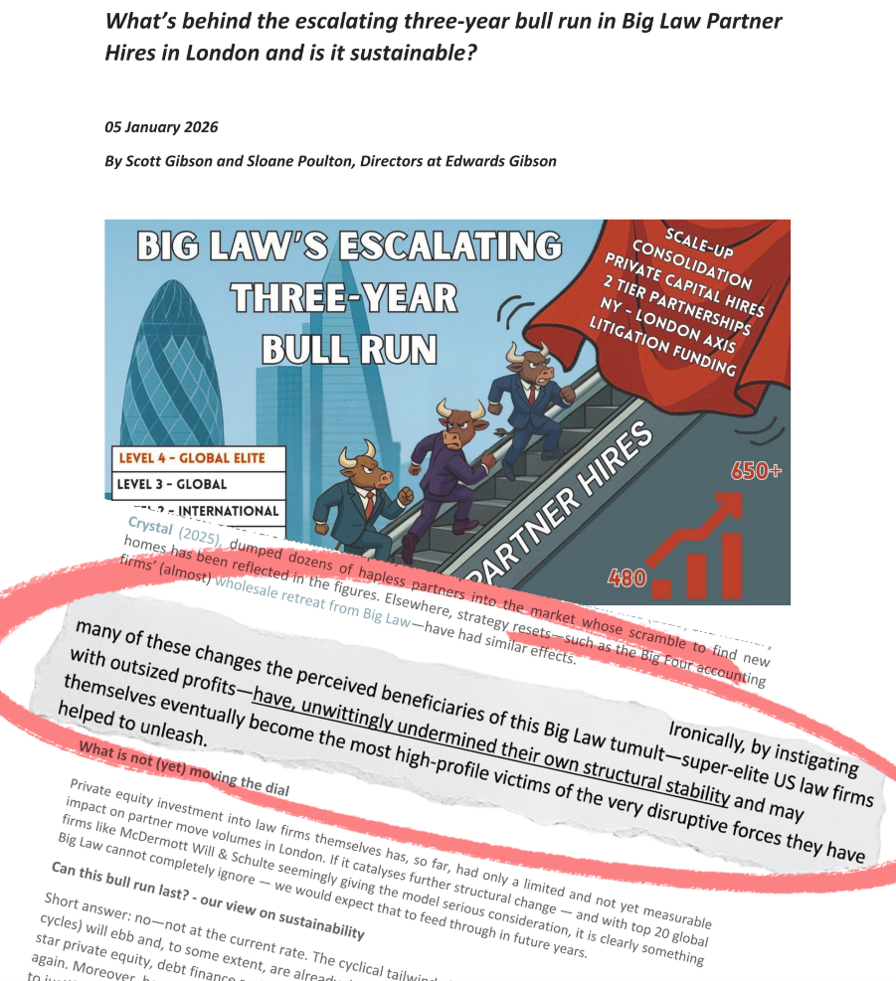
Our analysis, published in January 2026, What’s behind the escalating three-year bull run in Big Law Partner Hires in London and is it sustainable? went further, warning that:
“Ironically, by instigating many of these changes the perceived beneficiaries of this Big Law tumult—super-elite US law firms with outsized profits—have, unwittingly undermined their own structural stability and may themselves eventually become the most high-profile victims of the very disruptive forces they have helped to unleash.”
We returned to the theme on the Non-Billable podcast in May 2026, arguing that elite US law firms were no longer the stable bastions they once were and that, once a handful of rainmakers leave, departures can snowball as partners who might otherwise prefer to remain are forced rationally to consider whether they can afford to be left behind.
We did not, of course, predict Weil specifically. What we did predict was that, over the past five years, the evolution of a particular cadre of elite US firms was making something like Weil increasingly likely. Law firm partnerships are inherently unstable, but combine concentrated and highly portable private-capital relationships, increasingly mobile rainmakers and relatively frictionless partner exits, and that instability becomes particularly acute. Once departures begin eroding confidence, the rational economic incentives facing those who remain can themselves accelerate the run on the partnership. Big Law Jenga was always a warning about what happens when enough pieces are removed from an apparently impregnable tower. With Weil, the tower finally fell.
© Edwards Gibson 2026
Download the PDF of this article here >>
-
Good Weil it lasts – US Big Law Elite
-
WilmerHale - The Born Defection
-
Pre-merger paradox – some atypical hiring
-
Uno Reverse - Kirkland vs Paul Weiss
-
The maybe (not-so) inviolate Slaughter and May
-
What’s behind the escalating three-year bull run in Big Law Partner Hires in London and is it sustainable?
-
Year End Big Law Tie Ups - and the standout is Hogan Lovells Cadwalader
-
“To: Cc or not Cc” – Clifford Chance's subversive new branding
-
Two Big Law Summer Weddings … and an Anniversary
-
Freshfields’ Non-Share Home Turf Handicap
-
Big Law Jenga: How Private Capital Stars Are Making Elite Firms Unstable
-
Big Law’s Brave “Few”, Their Inevitable Pyrrhic Victory, and Why This Is Still a Tragedy for The Rule of Law
-
No Accounting for the Big Four in Big Law
-
MIPIM 2025 Doppelgänger Style!
-
"Memery Loss" London Law Firm Memery Crystal Sinks
-
Lawyers should remember that the financial success of Big Law is predicated entirely on the Rule of Law
-
Paul Weiss - The invasive species that upset the London Big Law ecosystem
-
Paul Weiss - Happy Birthday to BigLaw's Apex Predator
-
Paul Weiss - Blackjack!
-
Breaking The Circle - the real significance of Freshfields pay bonanza is far more profound than just another Big Law salary arms race.
-
A lawyer's progress to partnership... and the closing window of opportunity
-
Linklaters – Welcome to the “Hotel California” of Big Law
-
The Pecking Order at MIPIM; believe it or not Real Estate Lawyers are not at the bottom!
-
Parallels in Peril, two midsize law firms – Axiom Ince and Stroock & Stroock & Lavan – collapse in the same month
-
And you thought $20 million was a lot for a lawyer…
-
Legal Upheaval: Kirkland & Ellis and Paul Weiss Exchange Blows
-
So, it’s A&O Shearman!
-
Real Estate lawyers - beware the £1,000 fish, and the true meaning of MIPIM … (literally)
-
Previous Issues of Partner Moves
-
Edwards Gibson Methodology for Compiling Partner Moves
-
Quantifying your following and writing an effective law firm business plan
-
Sample law firm business plan
-
The Partnership Track and Moving for Immediate Partnership
-
Legal directory rankings and their effect on lawyer recruitment
-
Restrictive Covenants and Moving on as a Partner
-
Competency Based Interviews - an overview
-
Verbal reasoning tests
-
Recruiting in-house lawyers - a guide for General Counsel/Legal Directors
-
London Law Firm Assistants Salary and Bonus, Trends and Predictions 2014-15
-
Compensation Packages for Expat US Lawyers in London – ‘COLAs’ Explained
-
London Law Firm Assistants Salary and Bonus, Trends and Predictions 2013-14
-
The In-House Triumph over Law Firms - A Pyrrhic victory?
-
London Law Firm Assistants Salary and Bonus, Trends and Predictions 2012-13
-
London Law Firm Partner Compensation 2012-13
-
The rise and fall of the elite investment bank lawyer
-
Attracting and retaining top talent to an in-house legal department
-
London Law Firm Assistants Salary and Bonus, Trends and Predictions 2011-12
-
FAQs about legal recruiting
-
The successful business lawyer